

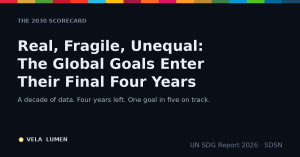
Of the 139 targets with enough data to judge, only about a third are on track or making moderate progress. Nearly half are advancing too slowly, and roughly one in six has slipped below where it stood in 2015. The Sustainable Development Solutions Network, applying a stricter test, is blunter still — just 16.5% of targets on track, and not one of the 17 Goals on course for 2030.
And yet the decade’s gains are not abstractions. Internet access has jumped from 40% to 74% of humanity. Electricity now reaches 92% of the world, with renewable capacity per capita more than doubled since 2015. New HIV infections are down 30%, AIDS-related deaths have halved since 2010, and roughly a billion more people have safely managed drinking water. UN Secretary-General António Guterres calls the 2030 vision still “within reach” — but only with what he terms a “decisive final push.”
The split screen
What the aggregate scorecard hides is how goal-specific — even indicator-specific — progress has become. Health is the clearest case: child mortality has fallen from 44 to 37 deaths per 1,000, and the adolescent birth rate from 45.9 to 37.6 — while maternal mortality, at 197 deaths per 100,000, sits near three times its target. Two goals carry most of the good news: connectivity (Goal 9) and clean energy (Goal 7). The reversals cluster just as tightly — obesity and unsustainable agriculture (Goal 2), press freedom and corruption (Goal 16), and extinction risk (Goal 15). Climate is the starkest: 2025 ran 1.43°C above pre-industrial levels, and 117.8 million people were forcibly displaced by the end of 2025.
| Indicator | 2015 | Latest | Trend |
|---|---|---|---|
| Internet use (Goal 9) | 40% | 74% | Up |
| Access to electricity (Goal 7) | 87% | 92% | Up |
| New HIV infections (Goal 3) | — | −30% | Up |
| Under-5 mortality, per 1,000 (Goal 3) | 44 | 37 | Up |
| Safely managed drinking water (Goal 6) | 68% | 74% | Up |
| Women in parliament (Goal 5) | 22.3% | 27.4% | Up |
| Food insecurity (Goal 2) | 1.6bn | 2.3bn | Down |
| Global temperature (Goal 13) | ~1.0°C | 1.43°C | Down |
| People forcibly displaced (Goal 16) | ~65M | 117.8M | Down |
| Official development assistance (Goal 17) | 2015 level | −23.1% (2025) | Down |
The financing squeeze
The most consequential story sits in Goal 17 — the plumbing beneath all the others. Official development assistance fell a record 23.1% in 2025, dragging aid back to 2015 levels. The external debt of low- and middle-income countries reached a record $8.9 trillion, against an annual financing gap of roughly $4 trillion. The tools are arriving as the funding retreats. With COP31 approaching and the 2030 clock running down, the question is no longer whether the Goals can move the needle — the decade proves they can — but whether the capital and cooperation can be marshalled fast enough to scale the wins before the reversals define the record.
Sources: The Sustainable Development Goals Report 2026 (UN DESA / UN Statistics Division); Sustainable Development Report 2026 (SDSN).


