

The Smell of Something Wrong
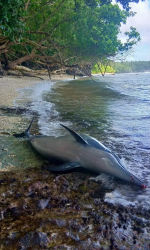
Across the eastern coastline of New Ireland Province in Papua New Guinea, something has gone deeply wrong with the sea. Since December 2025, thousands of dead fish have been washing ashore — bluestripe herring, eels, octopus, lobster, sea cucumbers, even a blacktip reef shark. Many of the fish have no eyes. A sulfurous smell, described by residents as like rotten eggs but many times more intense, hangs in the air near the water's edge.
At least 750 people have reported severe skin rashes, blisters, swelling, respiratory distress and gastrointestinal illness after contact with the seawater. A 12-year-old boy who jumped in to cool off after working in the heat emerged with his face swollen shut around one eye. Children who relied on fishing to pay for school transport and lunches have stopped attending school. Communities that have lived alongside and from this ocean for generations are now afraid to enter it.
"Our life is centered around the ocean," said Rebecca Marigu, an environmental journalist from New Ireland documenting the crisis on the ground. "That's our source of income, source of protein."
How a Scouting Trip Became a Relief Mission
Bodhi Patil arrived in Papua New Guinea in March on an InnerLight Foundation trip to assess ocean stewardship programs in the region. While there, working with InnerLight grantee Emma Oliver, he encountered the scale of what was happening in New Ireland and knew immediately that the plan had to change.
What followed was a rapid pivot from observation to action. Patil began documenting conditions on the ground and sharing them through social media, quickly connecting local leaders, scientists and international advocates through a WhatsApp group — PNG Toxic Ocean Rapid Response — that now numbers more than 300 members. He connected with John Aini, founder of Ailan Awareness, an Indigenous-led marine conservation organization in New Ireland, whose community survey over five days documented nearly 3,500 dead marine animals washing ashore — with many more uncounted offshore.
Together, Patil and Aini mobilized an international response. InnerLight issued an emergency grant to Ailan Awareness, and a community fundraising campaign surpassed $10,000 toward a $15,000 target, with funds directed to water tanks, medical supplies, skin treatments and supplemental food for communities cut off from their primary protein source.

Papua New Guinea's Conservation and Environment Protection Authority collected water samples earlier this year. As of this recording, results had not been publicly released. The country's Minister for Fisheries and Marine Resources issued a public warning urging coastal residents not to eat fish from affected waters — a directive that carries profound consequences for communities with no immediate alternative.
Scientists examining the evidence point to a likely convergence of factors. New Ireland sits within the Coral Triangle — a roughly six million square kilometer marine region spanning six countries and considered the global epicenter of marine biodiversity. Its coastal ecosystems are intricate and interconnected, making them both extraordinarily rich and acutely vulnerable.
Palm oil plantations operating near rivers and the coastline are one line of inquiry. During the December-to-March monsoon season, pesticides, herbicides and fertilizers can move rapidly from land to sea through porous limestone soils and sandy sediment, flowing into nearshore reef systems where communities fish. Sargassum — a type of harmful macro-algae spreading in tropical waters globally — has also been observed in significant quantities in New Ireland's coastal waters. As it decomposes, it depletes oxygen and can release hydrogen sulfide gas, the likely source of the sulfurous odor residents describe.
"I wouldn't say there's one particular culprit here," said Rachel Sapery James, an Indigenous marine scientist from New Ireland and WWF Coral Reef Rescue Initiative lead. "I think there's a lot going on in this system at play."
What This Moment Demands
For John Aini, who has spent decades advocating for coastal communities in New Ireland — and who recently appeared in Will Smith's National Geographic series Pole to Pole — the silence from authorities has compounded the suffering. "I am thinking about my people," he said, "and how responsible authorities are keeping them in the dark and not providing relief."
The immediate ask is clear: water quality testing accessible to local communities in real time rather than dependent on distant laboratories, emergency medical supplies, safe drinking water and food security for affected villages, and a transparent accounting of what is in the water and what caused it.
The longer-term ask is bigger. This crisis is a microcosm of pressures playing out across Pacific island coastlines — warming oceans, land-based industrial pollution, weakened environmental enforcement, and the near-total dependence of coastal peoples on marine ecosystems that industrial modernity is systematically degrading.
Hub Culture has followed ocean health as a core theme across the Chronicles podcast series, from conversations at COP27 and COP28 to the work of the Sustainable Ocean Alliance and the Ocean Climate Fund. The PNG crisis is not an isolated event — it is a signal, arriving from one of the world's most biodiverse marine environments, that the system is under stress we can no longer ignore.
How to Help
The Ailan Awareness emergency relief campaign and rapid response network can be found at linktr.ee/HealPNG.
Listen to Episode 126 of the Hub Culture Chronicles on Apple Podcasts, Spotify, and SoundCloud.
The Hub Culture Chronicles is hosted by Stan Stalnaker, Founding Director and Chief Strategy Officer of Hub Culture. 126 episodes. 2020–2026.


