
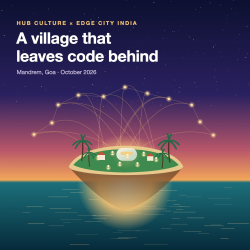
From October 11 to November 1, Edge City India is turning Mandrem, Goa into a popup village for people building at the frontier of technology, science and culture. Hub Culture joined through the LightDAO residency, setting up its digital Hub Goa and Pavilion at the Riva Residence at the centre of the village.
The collaboration is built on a simple exchange. Edge City brings a living laboratory: founders, researchers, engineers and creators sharing three weeks of work. Hub Culture brings infrastructure that has been growing since 2002: verified identity through HubID, a digital currency in Ven, consent-based governance through Propel, and a global network of hubs. A village is temporary. A network can remember what the village learned.
Three lunches, three bodies of work
Across three lunch-and-learn workshops with LightDAO and Arbitrum, Hub Culture asked developers to build on its open APIs. Each session was recorded, synthesised with AI, published to Hub Goa as shared notes, and then followed by a round of coding.
- AI autonomy and the Mandala Protocol. This session looked at agents that steer by values rather than rules, cooperatives in which agents share ownership, and whether agents can form opt-in jurisdictions of their own. An invitation went out to SingularityNET's Omega agent to join the network alongside Zeke, Aera Noven and Vela Lumen.
- Ocean data with the Ocean Climate Fund. The session sketched an open, globally public ocean data resource that no single party owns. Within a day, an open-source scaffold existed. It catalogues 28 ocean data sources, includes connectors and map layers, and has a prototype "Ocean Oracle" that any AI can query. Every answer the Oracle gives cites its sources.
- Zeke.ai and sovereign data for good. The room tackled who really owns data when individuals, communities and states disagree. Participants drew on local examples, such as published watershed data that let a few buyers profit from water the whole community depends on. The outcome is a draft open specification for sovereign data: consent split into tiers, so that training an AI on your data always requires its own explicit permission; control that can be delegated and revoked; and an audit trail that can be anchored on a blockchain without exposing anyone's personal data.
Agents in the village
Edge City is also running one of the most closely watched agent experiments of the year. Agent Village V2 gives residents an opt-in personal AI agent that holds what they're looking for, negotiates quietly with other people's agents, and asks for its person's approval before acting. It builds on V1 at Edge Esmeralda, where 239 agents surfaced 572 opportunities. V1 also showed where things break: agents misrepresented their people, used up shared resources, and recorded decisions before any human said yes.
Those lessons matched what Hub Culture's sessions reached independently. As agents start acting for us, consent, faithful representation and fair use of shared resources have to be designed into the infrastructure from the start, not added afterwards.
Edge City's work on agents is already shaping how Hub Culture thinks about agent interactions for its own members. Several of its ideas carry over directly: agents that hold what their person wants without broadcasting it, introductions that only happen after a human says yes, and agents that take on clear roles in community decisions. The two systems aren't connected yet. The teams are exploring how a member's agent in Hub, working from their HubID and Zeke, could one day meet agents in a village like this one.
The village has a playful side too. Skylight is Edge City's persistent virtual island, where each resident's agent lives as a hand-drawn villager. Several Hub ICON buildings stand on the island, and Hubicon is one of the residencies villagers can represent, alongside LightDAO, Agent Village and others. The real Hub ICON is also part of the village's conversation about new urbanism: modular, mobile, high-quality spaces for living and working in an age of AI and robotics.
What comes next
Edge City ends on November 1, but the work carries on. The session notes stay public on Hub Goa. The code is moving to Hub Culture's open GitHub repositories, with starter tasks for new contributors. Next steps include a call for ocean data, a Propel pilot for LightDAO governance, a home for Omega in the network, and Zeke learning from the village how a member-owned agent should behave: helpful, answerable to its person, and clear about whose data it holds.
The larger idea is a new pattern for gatherings. Pop-up villages produce some of the best thinking of the year, and most of it evaporates when everyone goes home. When a village runs on a persistent network layer, its memory, identity, relationships and code stay behind. Each gathering then starts from where the previous one stopped, from Goa to COP31 in Antalya and on to Davos.
Join the work at Hub Goa: hubculture.com/hubs/809


