

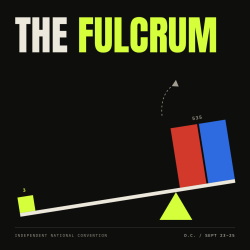
That challenge has a precise answer, and it isn't winning a majority. It's winning just enough seats that no one else can have one.
The arithmetic of leverage
Congress today is divided almost exactly down the middle. Republicans hold a 53–45 Senate majority, with two independents caucusing with the Democrats for an effective 47, and a 218–214 House majority. On margins that thin, a small bloc that refuses to join either party decides which way the chamber tilts.
The idea already has a name. Organizers call it the Independent Fulcrum Caucus, built on one commitment: its members agree not to caucus with Democrats or Republicans. The math is straightforward. Multiple organizations working separately have reached the same conclusion: electing even three or four true Independents in 2026, in either chamber, would deny either party an outright majority and force coalition governance.
In the Senate, the Vice President's tiebreak means the caucus holds the balance only if Republicans fall below 50, which is why every independent seat, and every competitive race around them, counts.
In the House, the Speaker needs a majority of members voting. A bloc of five independents in a near-tied chamber can withhold that majority until real concessions are made. In the Senate, whoever organizes the chamber controls committees and the floor. If neither party reaches 51 without independent votes, those votes can be traded for results rather than handed over for party loyalty.
This isn't speculative. Small blocs have always held this power in American politics:
•1923: Progressive Republicans held up the Speaker's election for nine ballots until they won rules reforms.
•2001: Jim Jeffords's single switch to independent flipped control of the Senate.
•2023: The Freedom Caucus showed how much leverage a few members hold, taking Kevin McCarthy through fifteen ballots.
The tactic works. The question is whether it gets used to obstruct or to reform.
Anyone who has watched parliaments in London, Berlin or Wellington knows this pattern. Smaller parties there routinely become kingmakers and write their priorities into coalition agreements. America is the outlier. Its winner-take-all system has let two parties share power without ever having to share it with anyone else.
The candidates who could make it real
Independent candidacies have never been this numerous. A Newsweek analysis found 217 independent congressional candidate entries in 2026: 170 for the House and 47 for the Senate. More importantly, several of them are actually competitive.
Nebraska: Dan Osborn vs. Sen. Pete Ricketts.
This is the flagship race. Democratic leaders backed a primary candidate who agreed to step aside so Osborn could face the Republican one-on-one, leaving no Democrat on the ballot in a state Trump won by about 20 points. Recent polling splits both ways. SurveyUSA shows Osborn ahead 46% to 42%, while Wedgewood Polls has Ricketts leading 52–48.
Idaho: Todd Achilles vs. Sen. Jim Risch.
Republicans haven't lost a Senate race in Idaho since 1974, yet a new Advanced Targeting Research poll shows Achilles leading Risch 50% to 39%.
South Dakota: Brian Bengs vs. Sen. Mike Rounds.
Bengs, a retired Air Force officer, states the fulcrum strategy openly. His aim is an independent coalition that bridges the partisan divide: deny either party a majority, and independents become the fulcrum that forces bipartisanship in the Senate.
Montana: Seth Bodnar (open seat).
Montana shows the strategy's biggest risk as well as its promise. One poll has Bodnar beating Republican Kurt Alme 50% to 44% head-to-head, but with the Democrat still on the ballot, Alme wins the four-way race with 41%.
California's 6th: Rep. Kevin Kiley.
The first sitting member to make the leap. When Kiley left the GOP in March, he became the only independent in the House. He now faces Democrat Richard Pan in November.
The wider map.
Roughly 25 competitive House districts now have more independent voters than either Republicans or Democrats. Voters are signaling they're ready too. In a June Independent Center survey, 69.5% said they'd be likely to vote for a strong, well-funded independent who shared their views and worked across the aisle.
Why money is the heart of the matter
Every independent in these races is running against the same force: the flood of money unleashed by Citizens United.
The numbers from this cycle are staggering. Federal corporate political spending in these midterms has hit an all-time high of $646 million, 40% above the previous record set in the 2024 presidential cycle. Total political advertising reached $4 billion by mid-September, and the cycle may approach $6 billion. In the closing weeks, even a candidate with a large cash advantage can be swamped by super PACs and dark-money groups that raise unlimited funds.
The public has noticed. Sixty percent of voting-age Americans say billionaires have too much influence on the country's politics. Neither party will fix this alone, because both depend on the system as it is. That is the strongest argument for a caucus that answers to neither.
What the Fulcrum should demand
A swing caucus is only as good as its price list. Leverage used without a clear agenda turns into chaos. Leverage tied to specific demands turns into reform. The caucus should vote for a Speaker and a Senate majority only in exchange for concrete commitments:
•Open-floor rules. Guaranteed votes on bills that have bipartisan majority support, so leadership can no longer bury popular legislation.
•Full dark-money disclosure. Anyone funding political advertising above a set threshold gets named, including donors hidden behind 501(c)(4) pass-throughs.
•A functioning FEC. The commission's evenly split structure produces predictable deadlock and should be redesigned so the law actually gets enforced.
•Real limits on super PAC coordination. Close the loopholes that let "independent" spending operate as an extension of the campaign.
•Small-donor matching. Make a $50 contribution from a voter worth more than a $5 million check from a billionaire.
•A floor vote on a constitutional amendment. Put every member on record on overturning Citizens United.
The caucus should also champion the state-level route that is already underway. This November, Montana voters will decide whether to become the first state to bar corporations from spending on elections through a ballot initiative, a legal strategy that goes around Citizens United rather than challenging it directly. Versions of the measure, I-194, are active or under consideration in some 32 states.
Three victories in November
The movement doesn't need a wave. It needs a handful of wins in the right places, and a caucus disciplined enough to trade its votes only for reform. In a Congress divided nearly in half, three or four senators and five House members could accomplish what decades of third-party presidential runs never did: make both parties negotiate with the voters in the middle.
That's the fulcrum. Place it well, and a very small force moves a very large system.
Where critics will push back
•The amendment math doesn't work. Overturning Citizens United outright takes two-thirds of both chambers plus 38 states, or a new Supreme Court majority. A caucus can deliver disclosure, FEC reform and matching funds, but it can't deliver repeal.
•The legal path is untested. Even the Montana approach faces serious skepticism. UCLA law professor Richard Hasen calls it an "end run" around Citizens United that the Court's conservative majority is likely to reject.
•"Independent" is a label, not an agenda. These candidates range from prairie populists to a former Republican in California. Holding them together as a disciplined bloc is unproven, and critics will point out that the 2023 Speaker fight also showed how small-bloc leverage can produce paralysis rather than reform.
•Critics dispute how independent they really are. Republicans argue several of these candidates are Democrats in disguise. The NRSC calls candidates like Osborn "fake Independents" who would push liberal policies. Most of the viable Senate independents also depend on Democrats standing down, which undercuts the "neither party" framing.
•The polls are soft. Several of the favorable polls are campaign-sponsored or come from partisan-leaning sponsors. Prediction markets still price Ricketts as the favorite, with Osborn trading around 31 cents.
The spoiler risk is real. Montana shows that when both a Democrat and an independent stay in, the Republican can win with 41%. Critics on the left will argue independents fracture the anti-incumbent vote.
Despite these challenges, the illusion of two-party omnipotence is less resolute than it has been for a long time, backed by a voting population looking for responsibility and pragmatic governance beyond candidates beholden to the duopoly of party politics.


