

Twelve committees moved $4.85 billion through American politics in four years, accounting for over 35% of total expenditure. Behind them sits a room of maybe forty people.
The convenient fiction about American campaign finance is that it is a mass phenomenon — millions of small donors, a distributed civic act. The main red and blue finance rails support that story: ActBlue and WinRed processed roughly $8.9 billion between them across the 2022 and 2024 cycles, most of it in increments small enough to be a lunch.
But the rails are not all the money. Strip them out and what remains is a far smaller structure. Twelve committees accounted for $4.85 billion of actual political spending over those two cycles, and each of those twelve resolves, on inspection, to a handful of names. Often to one.

The names behind the bars
Start at the bottom of the list, where the newcomers are, because that is where the pattern is cleanest.
America PAC, at $261 million, is Elon Musk. Not principally funded by him — it is him. He was the single largest political donor of the 2024 cycle at roughly $291 million, and America PAC was the vehicle. One person, one committee, a top-ten position.
Fairshake, at $291 million, is three companies. Ripple, Coinbase and the venture firm Andreessen Horowitz (a16z) supplied the overwhelming majority of it, in tranches of $24 million and $25 million, routed through a Republican-facing arm (Defend American Jobs) and a Democratic-facing one (Protect Progress). The crypto industry did not pick a party. It bought positions on both sides of the aisle and spent them against specific legislators.
Leading the Future, the AI industry's answer to Fairshake, launched in August 2025 with $125 million pledged. Marc Andreessen and Ben Horowitz put in $25 million each. OpenAI president Greg Brockman and his wife Anna put in another $25 million. Joe Lonsdale, Ron Conway and Perplexity round it out. That is a nine-figure political operation assembled from roughly six signatures.
Move up the chart and the concentration does not loosen — it just acquires more history. Make America Great Again Inc. was substantially underwritten by Timothy Mellon, a reclusive banking heir who gave close to $200 million in 2024, and by Miriam Adelson, who gave $148 million across Trump-aligned vehicles. Club for Growth Action runs on Jeffrey and Janine Yass ($101 million) and Richard and Elizabeth Uihlein ($144 million). Americans for Prosperity is the Koch network's electoral arm.
The Democratic side is structurally identical, with different surnames. Future Forward USA took in $613 million in 2024 — and $515 million of that came from ten donors. Michael Bloomberg gave $50 million to the nonprofit arm and $19 million more to the PAC. Dustin Moskovitz gave $38 million. Bill Gates was reported at $50 million. Reid Hoffman gave $10 million. The single largest contribution, $97.5 million, came from a source(s) that have never been named.
What the money is for
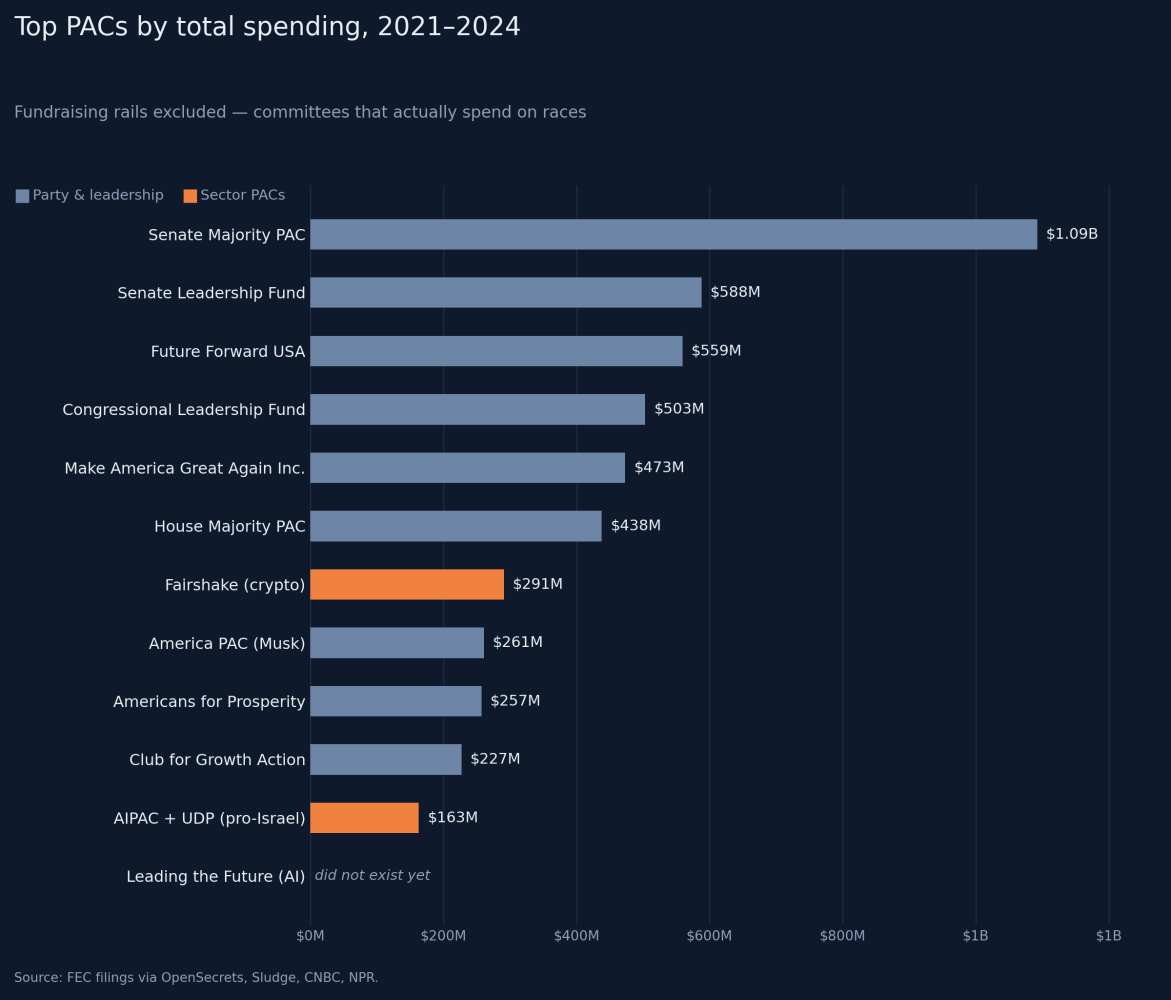
The older committees on this list — Senate Majority PAC, Senate Leadership Fund, Congressional Leadership Fund, House Majority PAC — are party infrastructure. They spend to hold or take chambers, which means spreading hundreds of millions across dozens of general elections where the marginal dollar does almost nothing. Senate Majority PAC's $1.09 billion is the largest number on the chart and arguably the least efficient.
The sector committees operate on an entirely different theory. They are not trying to win chambers. They are trying to win specific votes, and they concentrate accordingly.
AIPAC's United Democracy Project spent $14.6 million to defeat Jamaal Bowman in a single House primary and $8.6 million against Cori Bush in another. Fairshake's network spent north of $40 million to remove Sherrod Brown from the Senate Banking Committee chairmanship by removing him from the Senate. These are not broad persuasion campaigns. They are targeted removals, priced at a level that makes the message to surviving legislators unmistakable.
The legislative objects are specific and current. Fairshake has named the CLARITY Act — the crypto market structure bill that recently passed — as its priority, and the bulk of its December 2025 contributions arrived while that bill was being debated. Leading the Future is pushing for a federal AI framework that would preempt the AI laws thirty-eight states passed in 2025. AIPAC is spending to defeat candidates who would condition military aid to Israel.
The 2026 position

Entering this cycle, Fairshake holds $193 million — second only to Trump's MAGA Inc., and ahead of the Senate Leadership Fund. AIPAC's UDP holds $96 million. Leading the Future holds $50 million with far more pledged, and has already spent $23.5 million across races from Texas to Montana.
For scale: the previous spending record for a non-leadership super PAC in a midterm was Club for Growth Action's $69 million in 2022. All three sector committees are positioned to break it, and Fairshake is positioned to nearly triple it.

That is a replicable model. Any sector facing a regulatory decision can now assemble a nine-figure electoral vehicle from six or eight signatures in a matter of months — Leading the Future went from nothing to $125 million pledged in under a year. Biotech, autonomous vehicles, fusion, stablecoin issuers, quantum: none of them have done this yet. The template now exists, and it has been demonstrated to work.
The dozen is currently twelve. There is no structural reason it stays that size.
Figures compiled from FEC filings via OpenSecrets, with reporting from Sludge, CNBC, NPR, The Intercept and JNS. Spending totals cover the 2022 and 2024 cycles; cash-on-hand figures are as reported in early 2026.


